
Model
Enterprise Software Layer Model
A map for placing agent work before production: which system stays official, where the loop runs, and what has to commit.
Agentic AI does not float above the enterprise. A production agent runs tools in a loop against systems that were built to be slow, authoritative, and hard to change. The model is a map for placing that loop before anyone funds scale.
The demo stops when someone asks where the result posts, who approved it, and who supports it after the build team leaves.
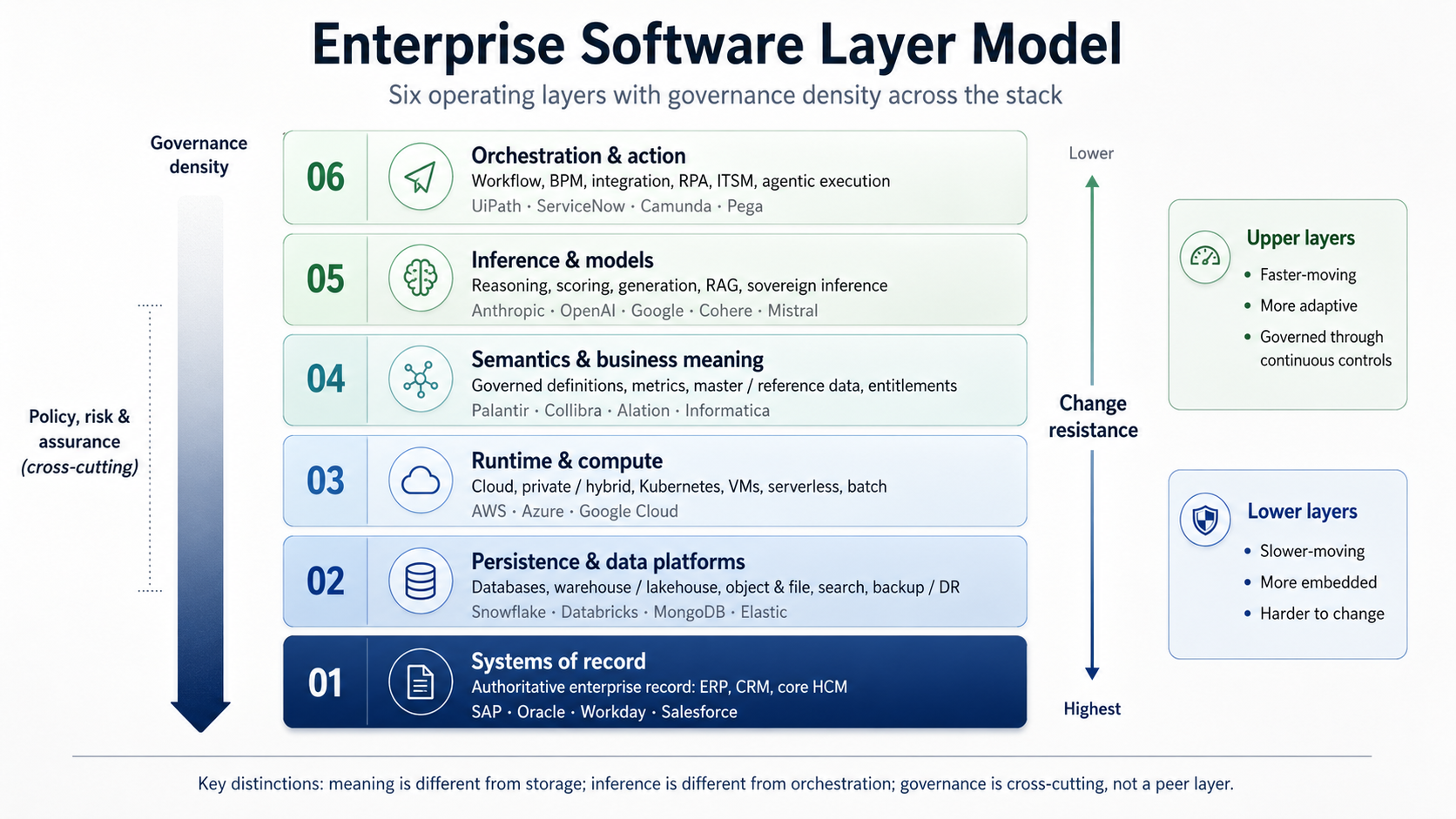
The stack
| Layer | What lives here | Why it matters for agents |
|---|---|---|
| Systems of record | ERP, CRM, HCM, finance, service records | Official facts. Expensive to unwind. Still authoritative. |
| Data platforms | Warehouses, lakehouses, indexes, logs | Access is not the same as trusted meaning. |
| Runtime | Cloud, containers, integration runtime | Where workloads run, fail, and get monitored. |
| Business meaning | Metrics, definitions, entitlements, rules | What the agent is allowed to treat as true. |
| Inference | Models, retrieval, classification, generation | Judgment: draft, score, recommend. |
| Orchestration | Workflow, tools, approvals, write-back, exceptions | Where the loop commits action and leaves evidence. |
Governance is not a box on top. It is permissions, policy, logging, review, and ownership across every layer the agent touches.
Record versus loop
Users rarely live in the ERP screen all day. Work sits in case tools, industry apps, and agent interfaces that read from several systems and write back to one.
If an agent changes a customer, refund, dispatch, or posting, the team must know which system remains official and how the result gets there. If nobody can answer that, the use case is still a prototype.
Inference versus orchestration
Inference is the model call. Orchestration is everything around it: which records were fetched, whether the user was entitled to see them, which tools ran, whether the result was validated, and whether anything wrote back.
Once the workflow updates a record or dispatches work, orchestration is the operating problem. Permissions, idempotent write-back, exception paths, and production support are not optional extras.
Before production
Before scale, name:
- The business result that has to move.
- The system that stays official if the workflow is wrong.
- Where business meaning is approved.
- Whether the agent produces judgment, commits action, or both.
- Who owns production support after launch.
Vague answers mean a useful experiment, not a production program.